

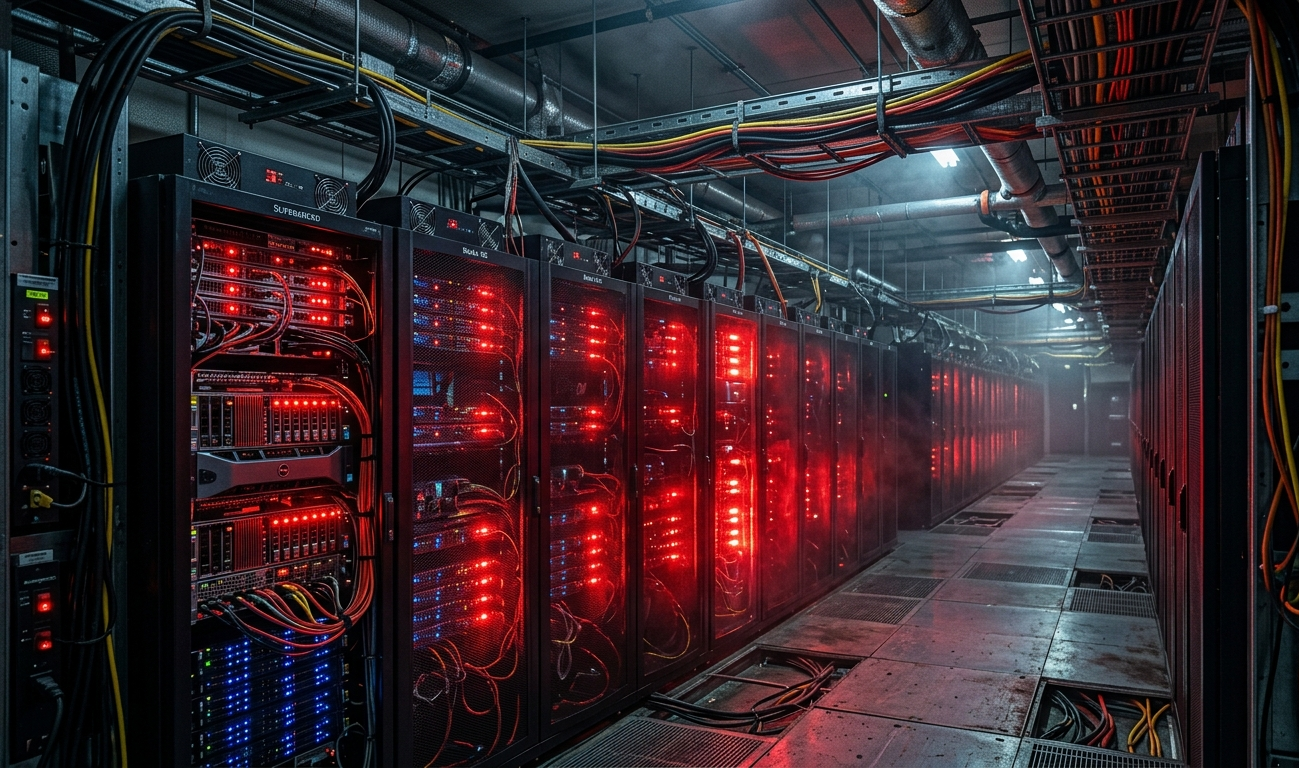
The real constraint on AI scaling isn’t compute. It’s the physical infrastructure surrounding it. Most existing data centers will fail under AI workloads — here’s the systems-level analysis.
Every serious AI deployment eventually hits the same wall — not a model limitation, not a software constraint. The ceiling is physical: power, thermal, and network infrastructure that was never designed for workloads like this.
The Assumption That’s Costing You
There’s a persistent belief in enterprise AI strategy that capability scales with compute. Buy more GPUs, provision more instances, expand your cluster — and your AI output improves proportionally. It’s a clean narrative. It’s also wrong.
The organizations actually running AI at scale — frontier model training, large-scale inference, distributed reinforcement learning — have learned the same lesson the hard way: the compute itself is rarely what fails first. What fails is everything around it.
Power delivery systems that weren’t engineered for sustained high-density draw. Cooling architectures designed for server workloads from a decade ago. Network fabrics built for north-south traffic patterns that bear no resemblance to the east-west-dominant communication of a GPU cluster in the middle of a training run. And physical facilities whose structural, electrical, and thermal envelopes were never conceived with these demands in mind.
This isn’t a software problem. It isn’t a procurement problem. It is a systems engineering problem — and most organizations are unprepared for it.
“The model doesn’t fail in theory. It fails when the power delivery system can’t sustain 85 kW per rack across a 500-rack cluster without voltage fluctuation.”
Why “More GPUs” Is an Incomplete Strategy
A single NVIDIA H100 SXM draws approximately 700W at peak. A full DGX H100 system — eight GPUs, NVLink interconnect, associated networking — sits between 10–11 kW. Scale that to a 1,000-GPU training cluster and you’re looking at sustained power draw in the 1.4–1.6 MW range, assuming a conservative utilization profile.
Now consider that most legacy enterprise data centers are designed around rack densities of 5–10 kW. The infrastructure math doesn’t work. You can’t retrofit a facility sized for general-purpose cloud workloads into something capable of sustaining a modern GPU cluster without confronting every layer of the physical stack simultaneously.
But power is only part of it. AI workloads introduce a distinct thermal signature. Unlike CPU-heavy workloads where heat is distributed and predictable, GPU-dense racks generate intense, localized heat — often exceeding 80 kW per rack in high-density configurations. The thermal management challenge is not incremental. It is categorically different.
Then there’s the network. A GPU cluster in training is not communicating with the outside world — it’s communicating with itself, continuously, at enormous volume. This east-west traffic pattern requires low-latency, high-bandwidth interconnects that traditional data center network architectures were not designed to provide at scale.
Three numbers that illustrate the gap:
- 80 kW+ — per-rack density in high-density GPU configurations
- 128 weeks — average US power transformer lead time at current market conditions
- $162 billion — data center investment currently blocked or delayed by grid constraints
Core Infrastructure Requirements for AI-Scale Workloads
Power Density and Delivery
Traditional enterprise data centers operate at 100–200W per square foot across the facility. Modern AI-optimized facilities need to sustain 500W+ per square foot in GPU-dense zones, with adequate redundancy to prevent single-point failure from cascading through an active training run.
Redundancy architecture matters here in ways it rarely does for conventional workloads. An N+1 configuration — one backup component for every N active — is often insufficient. Serious AI infrastructure demands 2N redundancy on critical power paths: full duplication of UPS systems, PDUs, and feed infrastructure. A training run that fails at hour 47 out of 72 due to a power event is not just a technical failure. It is a capital destruction event.
Facilities need to be engineered around utility-grade power feeds, direct substation connections, and in many cases, on-site generation capacity. Planning for 10–50 MW at the facility level is no longer the domain of hyperscalers alone. Enterprise AI deployments are demanding 5–20 MW dedicated to compute infrastructure — a requirement that eliminates most existing colocation and private data center options immediately.
Cooling Architecture
The cooling evolution underway in AI-capable data centers is not an upgrade cycle. It is a generational replacement.
Air cooling — the dominant approach in legacy facilities — becomes thermally inadequate above approximately 20–25 kW per rack. Computer room air conditioning units weren’t engineered to remove heat at the densities modern GPU clusters generate. At 50–80 kW per rack, you are fighting physics.
Liquid cooling has moved from niche to necessary. Direct liquid cooling — where coolant is delivered directly to heat-generating components via cold plates — can manage 50–100 kW per rack effectively. Rear-door heat exchangers offer a partially retrofittable option for moderate-density scenarios, but carry efficiency penalties relative to direct approaches.
Immersion cooling — submerging entire server boards in dielectric fluid — is the frontier solution for extreme density. It is capable of managing 100+ kW per rack with near-silent operation and dramatically improved energy efficiency. The operational model, however, is fundamentally different from anything most data center teams have managed.
Cooling Technology Comparison:
- Air (CRAC/CRAH) — Max 15–20 kW per rack | PUE 1.4–2.0 | Existing infrastructure
- Rear-Door Heat Exchanger — Max 25–35 kW per rack | PUE 1.2–1.5 | Partial retrofit possible
- Direct Liquid (Cold Plate) — Max 50–100 kW per rack | PUE 1.03–1.15 | New build preferred
- Single-Phase Immersion — Max 100–200 kW per rack | PUE 1.02–1.05 | New build required
- Two-Phase Immersion — Max 200 kW+ per rack | PUE 1.01–1.03 | Purpose-built only
Network Architecture
A GPU cluster in distributed training is not a collection of independent nodes exchanging messages occasionally. It is a tightly-coupled parallel computer, where every GPU communicates with every other GPU at high frequency and high volume throughout the training run. The network is not auxiliary to the compute — it is constitutive of it.
NVIDIA’s NVLink provides GPU-to-GPU bandwidth within a single node at 900 GB/s bidirectional in the H100 generation. Inter-node communication relies on InfiniBand — NDR InfiniBand at 400 Gb/s is the current dominant standard, with 800 Gb/s becoming available in next-generation deployments. Ethernet-based alternatives (RoCEv2) exist but introduce latency penalties that compound across large-scale distributed workloads.
The network topology matters as much as raw bandwidth numbers. Fat-tree and dragonfly topologies dominate large-scale GPU clusters, each with distinct tradeoffs in bisection bandwidth, path diversity, and cabling complexity. AI training demands oversubscription ratios far lower than traditional enterprise networking tolerates — often 1:1 or 2:1 rather than the 4:1 to 8:1 common in general-purpose data centers.
Physical Facility Design
Tier III certification — concurrent maintainability, N+1 redundancy, 99.982% uptime — represents the minimum acceptable standard for enterprise AI workloads. Tier IV — fault-tolerant, 2N redundancy, 99.995% availability — is the target for workloads where downtime at scale means meaningful capital loss.
Floor load capacity is a constraint that surprises organizations new to high-density compute. Standard raised-floor data center construction assumes 100–150 lbs per square foot. Immersion cooling tanks and dense compute deployments can exceed 300–400 lbs per square foot. This is a structural engineering requirement that must be specified at the design stage — it cannot be addressed after build-out.
Where Current Infrastructure Fails
Power
Most existing enterprise data centers were designed for 5–10 kW per rack. The PDUs, UPS systems, and primary electrical feeds were sized accordingly. Upgrading them isn’t a matter of swapping components — it requires replacing primary electrical infrastructure, including switchgear, transformers, and feed cabling.
The compounding factor: grid interconnection queues in constrained markets like Northern Virginia stretch to 5–7 years. A transformer replacement alone carries a 128-week lead time at current market conditions. Organizations that didn’t begin power planning three years ago are already behind.
Cooling
Legacy air cooling infrastructure can’t sustain high-density GPU clusters. Even facilities with modern CRAH units hit thermal limits well below what AI hardware requires. Retrofitting liquid cooling into an existing facility carries 2–3x the cost of designing for it from the start, and introduces operational disruption during the transition period — precisely when reliability matters most.
Network Fabric
Existing data center network infrastructure was designed for north-south traffic: client-to-server communication, Internet egress, SAN access. The east-west, all-to-all communication patterns of GPU clusters in training require a fundamentally different topology, cabling architecture, and switch capacity.
InfiniBand is a specialized domain. Most data center network teams have deep expertise in Ethernet — Cisco, Arista, Juniper. InfiniBand requires different operational knowledge, different management tooling, and different troubleshooting disciplines. The skills gap is real and not quickly closed.
Workload Mismatch by Design
Facilities being built today for training-era density are entering a market shifting toward inference. Training workloads demand extreme centralization — thousands of tightly-coupled GPUs in a single facility. Inference workloads demand geographic distribution, lower-latency access, and a different power density profile.
By 2027, inference is projected to represent the majority of AI compute spend. Facilities designed on 2024–2025 assumptions will open into a market that has already moved past them.
The System-Level Implication: Infrastructure as the Moat
For the past decade, competitive advantage in AI was primarily a software problem. Which organization had the best research team, the best training methodology, the best fine-tuning approach for a specific domain? These were the questions that determined outcomes.
That is changing. As models converge — and they are converging, across all major frontier labs — the differentiator shifts from what you can train to what you can run, at what scale, at what cost, and with what reliability. These are infrastructure questions.
The organizations that secure gigawatt-scale power commitments today are not just building data centers. They are creating decade-long competitive barriers. Those that master liquid and immersion cooling operations are building operational competencies that take years to develop and cannot be acquired quickly. Those deploying and operating InfiniBand-based GPU clusters at scale are accumulating systems engineering expertise that has genuine market value.
Infrastructure has become the moat. Not because software doesn’t matter, but because infrastructure scarcity — particularly power and thermal capacity — is now the binding constraint on what any organization can do with AI, regardless of model quality or software sophistication.
“In the next phase of AI competition, the question isn’t which model is smarter. It’s which organization can run the smartest model at scale without the building catching fire — metaphorically or literally.”
Where Capital Should Actually Move
The investment narrative around AI has been dominated by semiconductor companies, model labs, and application-layer software. This is an incomplete picture. Sophisticated infrastructure capital is already moving accordingly.
Priority Tier 1: Power Infrastructure Utility-adjacent assets — substation capacity, grid interconnection rights, long-term PPAs with renewable sources. Organizations that control power access control AI access. The constraint is real and the lead times are prohibitive.
Priority Tier 1: Thermal Management Liquid and immersion cooling providers, coolant distribution unit manufacturers, facility engineering firms with liquid cooling deployment expertise. This market is growing rapidly and the supply of qualified operators is severely limited.
Priority Tier 2: High-Performance Networking InfiniBand switching infrastructure, optical interconnect components, network fabric design and integration services. As GPU cluster sizes grow, the network investment required grows superlinearly. This is an underappreciated capital requirement.
Priority Tier 2: Purpose-Built AI Facilities Greenfield data center development designed from the ground up for AI workloads — correct structural specifications, liquid cooling rough-in, high-density electrical infrastructure, and geographic positioning relative to power sources and fiber routes.
Priority Tier 3: Operational Expertise Managed services firms, staffing, and training programs that can build and operate AI-capable infrastructure. The skills gap is severe. Organizations that can reliably operate high-density, mixed liquid/air environments will command significant premiums.
Monitor: Legacy Data Center Assets Existing general-purpose facilities face a bifurcated outcome: those with upgrade paths to AI-relevant density command premium positioning; those without face structural demand erosion as enterprise workloads migrate to purpose-built AI environments.
One investment category notably absent from most infrastructure discussions: operational software for AI-specific data center management. GPU cluster monitoring, thermal telemetry, power envelope management, and predictive maintenance tooling for liquid-cooled environments are underdeveloped relative to the underlying hardware complexity. This is a quiet opportunity.
The Closing Argument
Every major AI failure that makes headlines is framed as a model problem, a data problem, or a strategy problem. Rarely is it framed as what it often actually is: a systems problem. An infrastructure that couldn’t sustain the workload. A power envelope that didn’t support the cluster. A cooling system that throttled performance at precisely the wrong moment. A network fabric that introduced latency the distributed training algorithm couldn’t tolerate.
The organizations advancing their AI capabilities fastest right now are not primarily distinguished by their model sophistication. They are distinguished by their ability to run powerful models reliably, at scale, continuously — which is an infrastructure achievement, not a research achievement.
Most data centers will not meet the requirements of serious AI workloads. Not because the engineers who built them made bad decisions, but because those decisions were made in a context that no longer exists. The infrastructure assumptions of 2018 are not the infrastructure requirements of 2026.
The executives who understand this early enough will make decisions — about site selection, capital allocation, vendor relationships, and operational development — that give them a durable systems advantage. The ones who don’t will spend the next several years retrofitting, at two to three times the cost, into a market that has already moved past them.
AI does not fail in the model. It fails in the building. And most buildings aren’t ready.
AEM Analytics Consulting advises enterprise operators and infrastructure investors on AI readiness assessments, power feasibility analysis, and workload architecture alignment. Our assessments are conducted before capital is committed — not after it’s stranded.
Request Your AI Infrastructure Assessment → https://calendly.com/brandy-smith-aemanalyticsconsulting/new-meeting
AI performance isn’t limited by compute—it’s limited by how your systems move data. Most architectures fail long before GPUs reach their limits.