

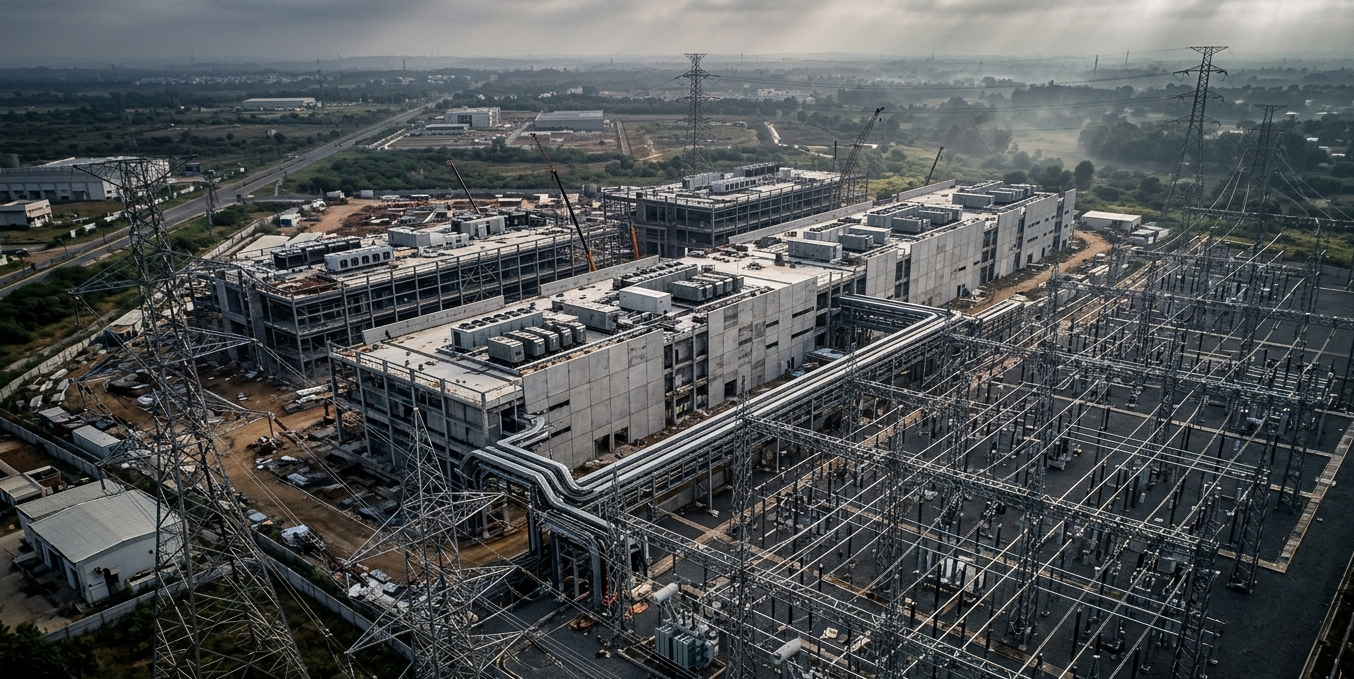
Most data center site decisions being made right now are built on the wrong foundation.
Not because the teams making them are careless.
Because they are using a decision framework designed for a world that no longer exists. The variables that drove site selection in 2020 — land cost, proximity to metro areas, tax incentives, fiber availability — have not disappeared. They have simply stopped being the variables that determine whether a project succeeds or fails.
The variable that now determines success or failure is power. And most real estate decisions are treating it like a line item when it is, in fact, the gate.
“In 2026, data center site selection is driven by one factor: deliverable power. If developers cannot secure megawatts on a predictable timeline, incentives, land costs, and fiber connectivity become secondary.”
The organizations still optimizing for land cost and tax abatement are making $100M–$500M decisions using a fundamentally outdated model. Some of those decisions are being locked in right now. The consequences will not be apparent for 18 to 24 months — which is precisely when they will be irreversible.
The Old Variables and Why They Fail
The traditional site selection framework for data centers was rational for its time. It looked something like this:
Land cost — minimize cost per acre in markets with available parcels
Proximity to metros — minimize latency to end users and employee commute burden
Tax incentives — capture state and municipal abatements that improve project economics
Fiber connectivity — confirm multi-carrier access and diverse route availability
Power — confirm that utility service is available, treat it as a standard due diligence item
This framework worked when data center workloads were predictable, rack densities were modest, and the grid had meaningful slack capacity in major markets. None of those conditions still apply.
AI workloads are not predictable or steady-state. They are bursty, high-density, and thermally intense in ways that the grid was never designed to accommodate. Rack densities have moved from 5–10 kW per rack to 30–80+ kW per rack in GPU-dense configurations. And the grid — particularly in historically dominant markets like Northern Virginia and Silicon Valley — does not have slack capacity. It has interconnection queues that stretch to 7 years.
Data center site selection is now fundamentally governed by power availability, forcing a geographic diversification away from historically dominant but power-constrained primary markets toward secondary and tertiary regions with available grid capacity.
The organizations that have not restructured their site selection frameworks around this reality are not behind the curve. They are operating on a different curve entirely.
The New Decision Hierarchy
Here is what the correct site selection framework looks like in 2026:
1. Power Availability — Can you get the megawatts you need, on a timeline that matches your project schedule?
2. Grid Topology — How far is the site from a substation with available capacity? What is the interconnection queue position?
3. Water Access — Is there sufficient water supply for cooling at scale? What are the regulatory constraints?
4. Fiber Route Diversity — Are there multiple diverse fiber paths with genuine redundancy?
5. Regulatory Environment — What is the political posture toward large load additions? Are curtailment frameworks emerging?
THEN — Land cost, tax incentives, metro proximity
The ordering matters. Rather than securing a site and then figuring out power, sophisticated developers now work backward: identify where power is available, then assess whether those locations meet other project requirements.
This inversion is not an optimization. It is a structural requirement. Every other variable in the decision tree is negotiable. Power is not.
What the Numbers Actually Show
Three data points illustrate the severity of the misalignment:
128 weeks. The average U.S. lead time for a power transformer at current market conditions. This is not a queue you can negotiate your way around. It is a physical manufacturing constraint. A site that requires transformer procurement is a site that is, at minimum, two and a half years from energization before a shovel breaks ground.
4 to 10 years. Across major U.S. markets, grid interconnection timelines now stretch from four to ten years, forcing developers to screen locations based on time-to-power before they evaluate traditional real estate factors. A developer who secured a site in Northern Virginia in early 2024 on the assumption of reasonable interconnection timelines may not achieve commercial operation until the early 2030s.
$162 billion. The volume of data center investment currently blocked or significantly delayed due to grid constraints. This is not speculative capital. It is committed capital sitting behind a power gate.
The geographic distribution of new AI data center projects is now dictated by power availability and grid capacity, driving development away from traditionally dense but power-constrained markets toward new regions with energy surpluses.
The market is already moving. The question is whether your site selection framework has moved with it.
The Markets Winning — and the Markets That Already Lost
Northern Virginia built its data center dominance on proximity to government demand, fiber infrastructure, and a regulatory environment that welcomed large industrial development. None of that has changed. What has changed is the grid.
Between 2021 and 2024, data center development was heavily concentrated in established hubs like Northern Virginia and Silicon Valley. Starting in 2025, the calculus has changed. Acute power constraints and grid interconnection bottlenecks are effectively closing these primary markets to new, large-scale development.
The markets winning right now share a different set of characteristics: proximity to generation sources, available substation capacity, water access for cooling, and a regulatory posture that is welcoming rather than hostile to large load additions. They are often not the markets anyone was paying attention to three years ago.
Operators appear to be increasingly exploring secondary and tertiary markets where land and energy are more accessible, signaling a shift away from traditional Tier-1 hubs.
The new map is being drawn around power-rich regions — not population-dense regions. The organizations that identified this shift early are already in queue for interconnection in markets that will be operational when the traditional hubs are still negotiating utility studies.
The Hidden Variable Nobody Is Underwriting
There is a variable that even sophisticated site selection processes routinely underweight: regulatory posture at the grid operator level.
Interconnection approvals are not purely technical decisions. They are also political and economic ones. Grid operators are under increasing pressure from residential ratepayers, state legislators, and federal regulators as large industrial loads — particularly data centers — strain regional grid infrastructure.
Energization may take up to 10 years in some areas due to long interconnection queues. Applications requiring minimal latency need proximity to population centers and robust telecommunications infrastructure, while those that house critical functions demand redundant power supplies.
This means a site with technical feasibility can still fail commercially if the regulatory environment shifts mid-development. A market with technical capacity but unstable political support may rank lower than a smaller market offering regulatory clarity.
This is not a risk that appears in standard real estate due diligence. It is not captured by a feasibility study that looks only at existing substation capacity. It requires an assessment of the grid operator’s posture, the utility’s relationship with its regulatory commission, and the political dynamics around large load interconnection in that specific market.
Most organizations are not asking these questions before site control is secured. The ones that are have a durable competitive advantage.
Where Capital Is Actually Moving
The infrastructure capital that is allocating correctly right now has restructured its entire approach to site underwriting. The competitive advantage in the next decade is not defined by who can build the biggest facility, but by who can secure the right land with a credible power path at the right time.
What that looks like in practice:
Power feasibility before site control. Not a utility estimate — a grid-operator-level assessment of queue position, substation capacity, and realistic energization timelines. This assessment happens before a letter of intent, not after.
Time-to-power as the primary IRR variable. A five-year delay erodes competitive positioning, compresses IRR, and shifts capital to faster markets. Every financial model that doesn’t stress-test for interconnection delay is modeling a scenario that may not exist.
On-site generation as a bridge strategy, not a fallback. 73% of respondents report actively evaluating or selecting onsite power providers, underscoring the growing emphasis on fast, predictable time-to-power. The developers closing leases are the ones who can demonstrate energization timelines, not the ones with the most attractive land positions.
Geographic diversification as risk management. Single-market strategies carry concentration risk. Organizations pursuing large-scale deployments benefit from portfolio approaches that spread projects across multiple regions with different grid characteristics and regulatory frameworks.
The Decision Being Made Wrong Right Now
Here is the scenario playing out in real estate boardrooms across the country:
A developer identifies a large parcel in a market with strong tax incentives and reasonable land cost. The site is within a reasonable distance of a major metro area. The utility confirms that power service is available. The team moves toward site control.
What the team did not assess: the interconnection queue position for that substation. The utility’s definition of “available” included a queue of 47 prior applicants requiring grid studies. The realistic energization timeline for a 100 MW facility at that location is 6 to 8 years.
The project pencils on paper. It will not deliver on schedule. And the lease conversations that were assumed to begin at opening — with institutional tenants who have already moved to faster markets — will not happen.
Interconnection has shifted from a technical hurdle to a core underwriting variable in data center site selection. A decade ago, developers optimized for the lowest delivered cost. In 2026, they are optimizing for earliest energization.
The developers who have not internalized this shift are still optimizing for a metric that no longer determines outcomes.
The Closing Argument
Every major site selection mistake has the same structure: the decision was made using the right framework for the wrong era.
Power was a detail. Now it is the gate. Grid topology was a technical specification. Now it is a strategic variable. Water access was an operational consideration. Now it is a site viability constraint.
The organizations that understand this are making site decisions that will look prescient in three years. The ones that don’t will be retrofitting — at two to three times the cost — into a market that has already allocated the best power positions to someone else.
Real estate picked the wrong variables. The correction requires more than updating a checklist. It requires rethinking the entire decision sequence — starting with power, working backward to land, and treating every other variable as secondary until the power question is definitively answered.
The sites that will anchor the next decade of AI infrastructure are being selected right now. Most of them will be chosen correctly. Some will not. The difference is not capital, ambition, or technical capability.
The difference is whether the team running the site selection process understands that they are making a power infrastructure decision first, and a real estate decision second.
AEM Analytics Consulting advises enterprise operators and infrastructure investors on AI readiness assessments, power feasibility analysis, and workload architecture alignment. Our assessments are conducted before capital is committed — not after it’s stranded.
Request Your AI Infrastructure Assessment →